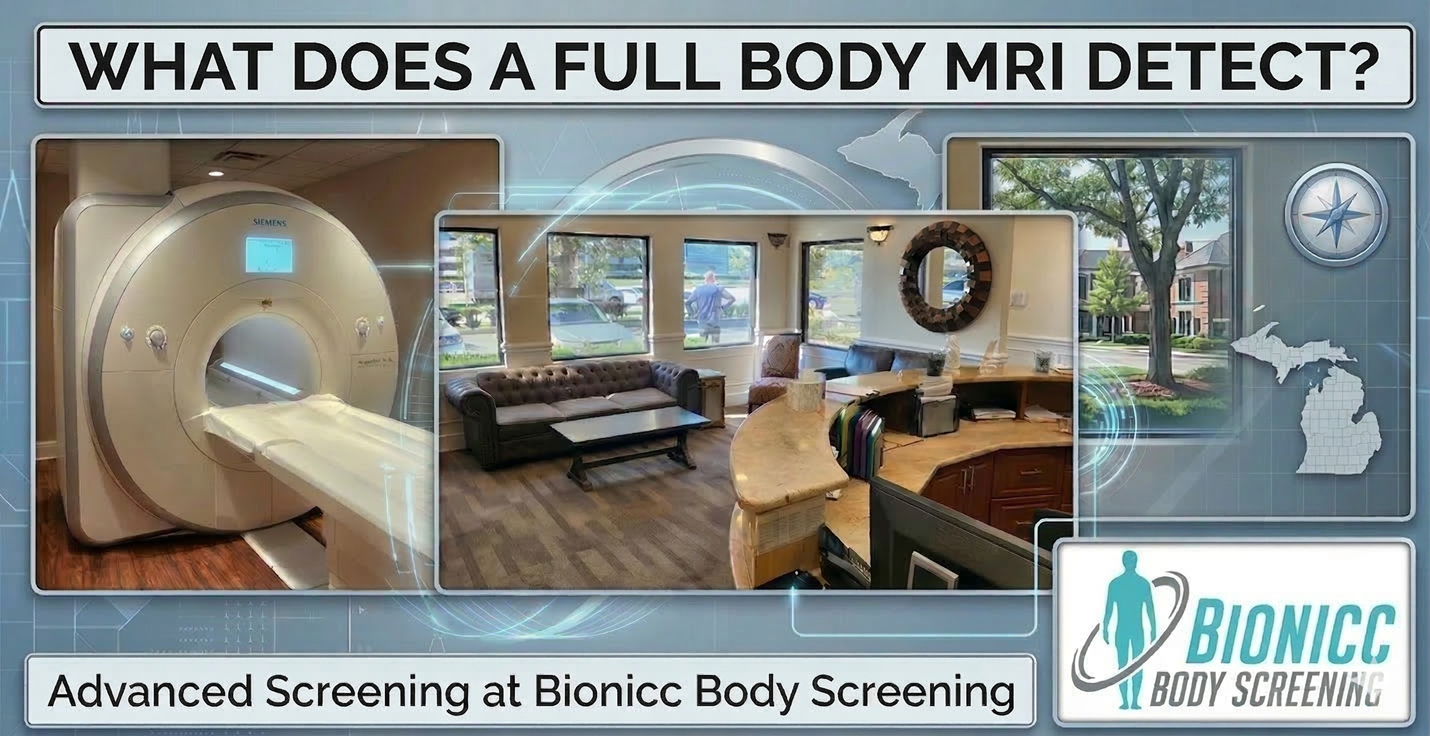
In an era where preventative medicine is gaining increasing importance, a full body MRI scan has taken center stage. In this article we answer the question, “How does a full body MRI work in Michigan and what does it detect?”
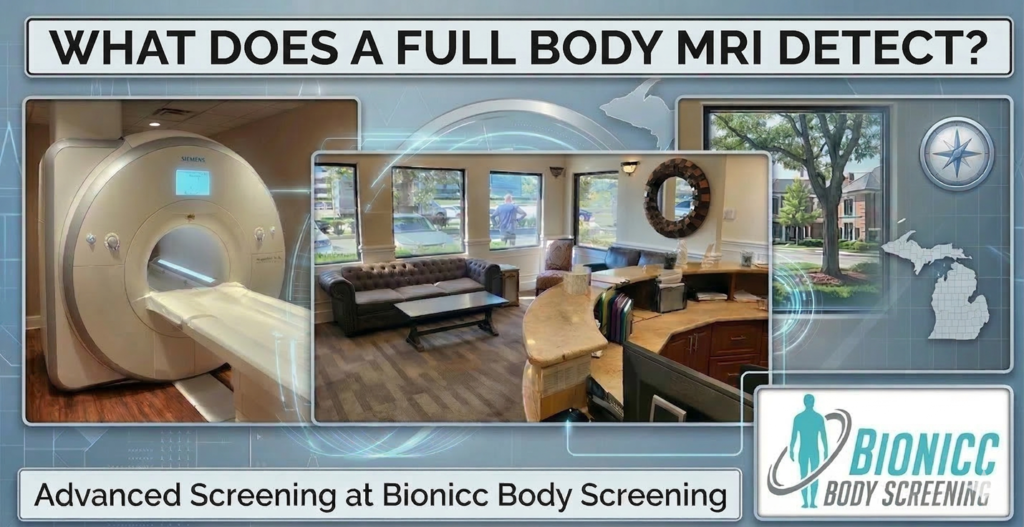
Bionicc Body Screening in Southfield, MI uses this cutting-edge tool to offer a comprehensive full body MRI in Metro Detroit to scan your body. It provides a detailed roadmap of your health.
The full body MRI is rising in popularity and accessibility. Also known as a whole body MRI scan, it is revolutionizing early disease detection, cancer screening and giving individuals the power to take control of their health like never before.
Imagine a single scan that could potentially uncover hidden health issues before they escalate – that’s the promise of a full body MRI scan.
Table of Contents
What is a Full Body MRI Scan?
MRI stands for Magnetic Resonance Imaging. It is a sophisticated medical imaging technique that utilizes powerful magnetic fields and radio waves to generate detailed images of the organs and tissues within your body.
Traditional MRIs typically focus on a specific area like your knee or brain. It is ordered by your doctor and may involve an injection of a contrast dye.
This is different than how a full body MRI in Michigan works. The full body MRI scans you from head to thighs. There are no injections. It is safe and radiation-free.
It provides a holistic view of your health. Think of it as a comprehensive “body audit” that can reveal a wealth of information about your well-being.
How Does a Full Body MRI in Michigan Screening Work?
During a Full Body MRI scan in Michigan, you’ll be asked to lie down inside a spacious, tunnel-like machine. This machine generates a strong magnetic field that aligns the protons within your body. Then, radio waves are emitted, causing these aligned molecules to produce faint signals. These signals are picked up by the MRI machine and processed by a powerful computer to create detailed cross-sectional images of your internal organs and tissues.
Unlike some diagnostic MRI tests, there is no contrast agent used during a whole body MRI scan, so it is non-invasive.
A contrast agent is a dye that is injected intravenously during a dedicated, diagnostic MRI. A dedicated MRI takes images of specific body parts to help highlight specific areas of concern.
As examples, blood vessels, injuries or tumors. This is usually done when evaluating abnormalities in a diagnostic setting. If a person had an abnormality detected during a whole body MRI scan, then their doctor may order an MRI of that specific body area.
This could include with or without a contrast agent to help diagnose the problem. It’s a bit like adding a highlighter to a map to pinpoint key locations.
What Can a Full Body MRI in Michigan Scan Detect?
The beauty of a full body MRI in Michigan screening lies in its versatility. It can detect a wide array of conditions across various systems in your body, including, but not limited to:
Cancers:
- Brain Cancer: A full body MRI screening is particularly effective in detecting brain tumors in its early stages, before cancer has spread and before experiencing symptoms.
- Liver Cancer: It can help identify tumors of the liver.
- Prostate Cancer: A full body scan visualizes the reproductive organs and can detect prostate tumors.
- Lung Cancer: Full Body MRI scans can identify lung masses before a person would experience any symptoms.
- Pancreatic Cancer: This often-silent cancer can be difficult to detect early. Full body MRI scans can help identify pancreatic abnormalities. This leads to quick interventions, easier treatments and better outcomes.
- Other solid tumors: It can detect tumors in the major organs of the body like the lungs, liver, kidneys, bladder, brain, thyroid, pancreas and reproductive organs, often before they cause noticeable symptoms.
Cardiovascular Disease:
- Aneurysms: A full body MRI scan can detect aneurysms, which are bulges in blood vessels that can rupture and cause life-threatening bleeding.
- Heart disease: MRI does not detect plaque in the heart. This is done by a CT scan. Your doctor can order routine screenings like calcium scoring and a CTA, which is used to identify heart disease and risk. Ask your facility if they offer CT scans before scheduling a whole body MRI screening.
- Stroke risk factors: By visualizing your carotid arteries, full body scans can identify plaque buildup or other abnormalities that increase your risk of stroke.
Neurological Conditions:
- Multiple sclerosis: Full body MRI can detect the characteristic lesions in the brain and spinal cord associated with multiple sclerosis.
- Brain tumors: It can identify brain tumors, determine their size and location, and help guide treatment decisions.
- Spinal cord abnormalities: Full body MRI screenings can visualize the spinal cord and detect abnormalities such as herniated discs, spinal stenosis, or tumors.
Other Conditions:
- Liver disease: It can assess the health of your liver and detect conditions like cirrhosis or fatty liver disease.
- Kidney disease: Full body MRI can evaluate kidney function and identify abnormalities such as cysts, tumors, or blockages.
- Arthritis: It can visualize arthritis of the hips, shoulders and spine.
What Are Benefits of Full Body MRI Screenings in Michigan?
Early Detection of Diseases: Perhaps the most significant benefit of a full body MRI scan is its ability to detect diseases in their earliest stages, even before you experience any symptoms. This early detection can be life-saving. It can allow for timely intervention and treatment, significantly improving your chances of a full recovery.
Non-invasive Procedure: A full body MRI in Michigan is a non-invasive procedure. This means it doesn’t involve any surgical incisions or injections. This makes it a safe and comfortable option for most individuals.
No Exposure to Radiation: Unlike CT scans, which use ionizing radiation, full body MRIs do not expose you to any harmful radiation. This makes it a safer alternative, particularly for individuals who require repeated imaging or are concerned about the long-term effects of radiation exposure.
Comprehensive Health Screening: At Bionicc Body Screening a full body MRI Michigan screening provides a comprehensive snapshot of your overall health. It’s like getting a detailed “owner’s manual” for your body. It highlights potential areas of concern and empowers you to make informed decisions about your health.
What Are Limitations of a Full Body MRI in Michigan?
Cost Considerations: Full body MRIs can be relatively expensive, and they are not be covered by insurance plans. Insurance companies view these screenings as purely elective and do not participate to offset the cost. MRI full body screenings are an investment in one’s health.
Potential for False Positives: Like any medical test, there’s a possibility of false-positive results, meaning the scan might indicate a problem where none exists. This can lead to additional testing and unnecessary anxiety.
Not Suitable for Everyone: A full body MRI in Michigan is not suitable for everyone. Individuals with claustrophobia (fear of enclosed spaces), certain types of metal implants (such as pacemakers), or other medical conditions might not be able to undergo the procedure. It’s crucial to discuss your medical history with your doctor to determine if a full body MRI scan is appropriate for you.
Who Should Consider a Full Body MRI in Michigan?
- Individuals with a family history of certain diseases: If you have a family history of cancer, strokes, or other conditions, a full body MRI can help assess your risk and detect potential problems early on.
- People with specific risk factors: If you have risk factors for certain diseases, such as smoking, obesity, or a sedentary lifestyle, a full body MRI can help identify potential health issues before they become serious.
- Proactive consumers seeking a comprehensive health assessment: If you’re proactive about your health and want a comprehensive assessment of your overall well-being, a full body MRI can provide valuable insights.
The Future of Full Body MRI Scans
The field of full body MRI screening is constantly evolving. There are ongoing advancements in technology promising to make these scans even more accurate, efficient, and accessible.
Researchers are exploring new techniques to reduce scan times, improve image quality, and expand the range of conditions that can be detected. In the future, Full Body MRIs may play an even greater role in preventative healthcare, helping individuals identify and address potential health issues before they manifest into serious illnesses.
Conclusion
A full body MRI is a powerful tool that can unlock the secrets to your health. It can provide a comprehensive view of your body. It can offer early disease detection. While there are limitations to full body MRI, its benefits are undeniable.
If you’re considering a Full Body MRI, consult with your healthcare provider. Discuss with them whether it’s the right option for you. Remember, early detection is key to successful treatment and recovery. A full body MRI can be a valuable investment in your long-term health and well-being.
To learn more about how a full body MRI works and what it detects, call Bionicc Body Screening in Southfield, Michigan at 833-Bionicc (833-246-6422).
Frequently Asked Questions and Answers
Can a full body MRI detect colon polyps?
No. A full body MRI does not detect colon polyps and does not replace a colonoscopy.
Does a whole body MRI replace mammograms?
No. A whole body MRI scan does not replace a mammogram and is limited on evaluating female breasts.
Why doesn’t a full body scan at Bionicc Body Screening include the arms and legs?
A full body MRI scan at Bionicc Body Screening scans from the head through the reproductive organs and does not include the extremities because it becomes time and cost prohibitive. Our proactive scans focus on the body’s core, vital organs for early detection of diseases like cancer.
What does a whole body MRI cover?
A whole body MRI at Bionicc evaluates from the top of the head through the pelvis and includes the brain, carotid arteries, oral pharynx, nasal pharynx, esophagus, thyroid, lymph nodes, lungs, hips, shoulders, pancreas, liver, gallbladder, kidneys, spleen, bladder, reproductive organs and spine.
Author: Ryan Ringold is the Managing Director and Patient Advocate at Bionicc Body Screening. Continuing the life-saving mission started by his father, Dr. Warren Ringold, Ryan is committed to changing how we value proactive healthcare. He specializes in breaking down complex preventative imaging data so individuals can confidently invest in early detection, broader treatment options, and true peace of mind.
All content is fact-checked by the Bionicc Clinical Team to ensure medical accuracy. | Last Updated March 18, 2026