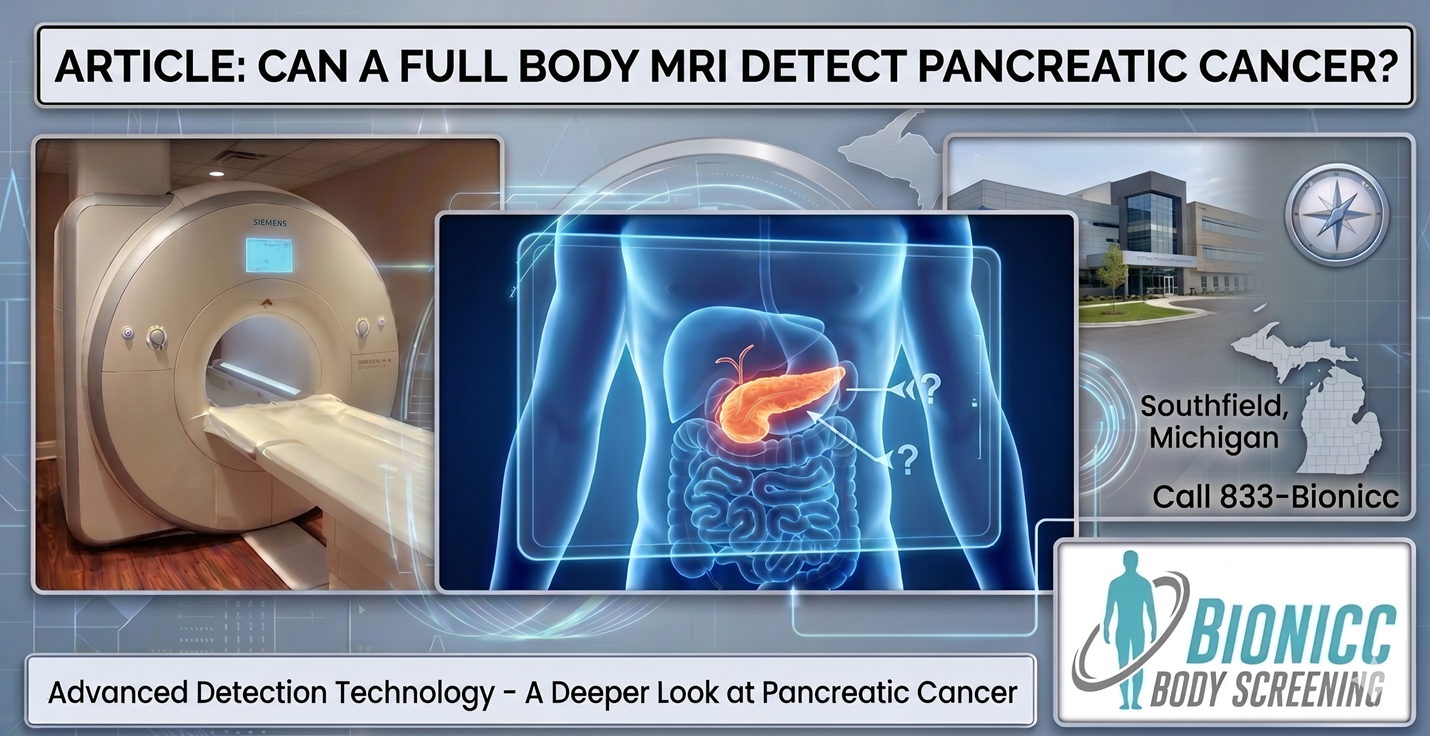
Full body MRI scans use advanced MRI technology to screen for early cancer and other conditions, but can a full body MRI detect pancreatic cancer? Yes, a full body MRI screening is capable of detecting pancreatic cancer early. At Bionicc Body Screening, we believe you shouldn’t have to wait for a crisis to get answers. We use MRI imaging to find health issues at their earliest stages, when they are much easier to treat. This is the heart of what we call “Medicine 3.0“—the move from reacting to sickness to proactively protecting your health.
Key Takeaways
- The Silent Threat: Pancreatic cancer is very hard to find early because it rarely shows symptoms until it has spread.
- A Massive Survival Gap: When found early and only in the pancreas, the five-year survival rate is 44%. If it spreads, it drops to 3%.
- Taking Control: Many patients have their early symptoms dismissed by doctors. Proactive screening gives you the power to see what’s happening inside your body.
- Safe and Detailed: A Full Body MRI at Bionicc Body Screening uses no radiation and provides a detailed view of your vital organs.
Woman Survives Pancreatic Cancer Twice After Doctor Dismissed Early Symptoms
Recently, a story in People magazine caught the world’s attention. A woman from St. Clair Shores, Michigan survived pancreatic cancer twice, even though her first symptoms were dismissed as simple acid reflux or anxiety. This story is a powerful reminder of a scary truth: our medical system often waits for you to be “sick enough” before it starts looking for real problems.
What is Pancreatic Cancer Early Detection?
Pancreatic cancer early detection is the process of finding small, often hidden tumors in the pancreas before they cause symptoms or spread to other parts of the body. Because the pancreas is located deep inside the abdomen, tools like a Full Body MRI are used to see through other organs and find tiny abnormalities that a physical exam would miss.
Why Is Pancreatic Cancer Hard to Detect?
The Problem with this “Silent Killer”
The pancreas is tucked away behind your stomach. Because of where it sits, doctors cannot feel it during a normal check-up. To make things harder, early pancreatic cancer usually doesn’t cause any pain or obvious signs, and pancreatic cancer disguises itself like a wolf in sheep’s clothing.
By the time a person notices something is wrong—like yellowing of the skin (jaundice), back pain, or weight loss—the cancer has often already grown quite large or moved to other organs.
This is why pancreatic cancer is often called a “silent killer.” In fact, as of early 2026, the overall five-year survival rate for all stages combined is just 13%. This number has stayed low for years because most people are diagnosed too late.
What is The Survival Rate of Pancreatic Cancer?
The data shows that timing is everything. If we catch the cancer while it is still “localized”—meaning it hasn’t left the pancreas—the survival rate is 44%. This is more than three times higher than the general survival rate. If the cancer spreads to distant parts of the body, like the liver or bones, the survival rate falls to just 3%.
| Pancreatic Cancer Survival by Stage (2026 Data) | 5-Year Relative Survival Rate |
| Localized (Found only in the pancreas) | 44% |
| Regional (Spread to nearby lymph nodes) | 17% |
| Distant (Spread to distant organs) | 3% |
| All Stages Combined | 13% |
Source: https://pancan.org/facing-pancreatic-cancer/about-pancreatic-cancer/survival-rate/
Why Do Doctors Sometimes Miss the Signs Of Pancreatic Cancer?
As seen in the story of the two-time survivor, early symptoms like stomach pain or digestion issues are very common. Doctors see these every day and often blame them on stress or diet. This is not because doctors are bad, but because standard imaging tests often fail to see the “last mile” of a small tumor. Standard CT scans, which are used in most hospitals, can miss up to 40% of small pancreatic cancers. These tumors are either too subtle for the human eye to see or are simply overlooked during a general scan. This creates a dangerous gap in care.
The Power of MRI and AI
Recent research from the Mayo Clinic shows that we can do better. Scientists are now using Artificial Intelligence (AI) to look at scans. These AI models can find hidden cancers in “normal” scans nearly a year and a half—about 475 days—before a doctor would typically find them. The AI technology is promising, but not ready to fully rely on.
At Bionicc Body Screening, we use a Siemens Magnetom Aera 1.5T MRI. This is a “wide-bore” machine, which means it’s more spacious and comfortable for you. It provides incredibly detailed pictures of your soft tissues, including the pancreas, without using any harmful radiation. Every scan is read by a Michigan-licensed, board-certified radiologist who knows exactly what to look for.
Is a Full Body MRI Right for You?
While anyone can benefit from knowing their internal health, some people are at a higher risk for pancreatic cancer. If you fall into one of these groups, regular screening isn’t just a good idea—it’s a vital part of your health plan.
Who is at High Risk?
- Family History: Having a parent, sibling, or child with pancreatic cancer increases your risk.
- Genetic Factors: Certain gene changes, like the BRCA2 or ATM mutations, are linked to a higher risk of several cancers.
- Lifestyle Factors: Long-term smoking and obesity are known risk factors.
- New-Onset Diabetes: Research shows that a new diagnosis of diabetes, especially if you are losing weight, can be an early warning sign of a pancreas problem.
Bionicc Body Screening Evaluates The Pancreas for Cancer in Metro Detroit
Most screening centers use a “one-size-fits-all” approach. Bionicc Body Screening is different. Our full body MRI takes about 70 minutes because we are unhurried and deliberate. We focus on the “core” of the body—where the heart, lungs, liver, and pancreas live. By evaluating the head, neck, chest, abdomen, pelvis and spine, our full body MRI can detect hundreds of conditions.
Unlike some national brands that use AI to speed up the scan, we believe in a careful, human-led approach. We focus on the areas where silent diseases are most likely to develop and not the knees, elbows and ankles.
Understanding the Cost and Value
We know that a preventative full Body MRI in Michigan is an investment. Our comprehensive packages range from $1,299 to $2,950. While that might seem like a lot at first, it’s important to think about the long-term value. (See our transparent Bionicc scan pricing.)
| Screening Package | Price | Focus Area |
| Full Body MRI | $2,950 | Head to Pelvis (Comprehensive) |
| Torso Screening | $1,999 | Chest, Abdomen, and Pelvis |
| Head & Neck | $1,299 | Brain, Neck, Carotid Arteries |
Many of our clients think about it this way: for about $8 a day over a year, you can have the ultimate peace of mind. That is less than the cost of a fancy coffee or a takeout lunch. When you consider that catching a problem early could save you hundreds of thousands of dollars in medical bills—and more importantly, give you more years with your family—the value is clear.
What Happens During a Scan?
The thought of an MRI can be scary for some, but we work hard to deliver the premium full body MRI service in Metro Detroit, making it a five-star experience.
- Preparation: You’ll arrive at our Southfield location and change into comfortable, metal-free clothing.
- The Scan: You will lie on a comfortable bed that slides into the wide-bore MRI. You can even choose your own music to listen to.
- The Wait: The scan is painless and takes about 70 minutes.
- The Results: Within two weeks, you’ll receive a detailed report discussing each area of the body the scan evaluates. You’ll also receive a DVD containing all your images. A qualified medical professional will contact you by phone to explain any findings and answer your questions.
We never have hidden fees or upcharges. What you see on our pricing page is what you pay.
Taking the First Step Toward Peace of Mind and Longevity
The story of the woman who survived cancer twice shows us that we cannot always rely on the “standard” way of doing things. Sometimes, you have to be the CEO of your own health.
A Full Body MRI isn’t about looking for something to be afraid of. It’s about finding the control you need to live a long, healthy life. Whether we find that everything is perfect or we find a small issue that needs attention, you win because you have the facts.
Schedule a Full Body MRI Screening at Bionicc in Southfield, MI
If you have questions about our Full Body MRI in Michigan, our team is here to help. You don’t need to be sick to want answers. You just need to care about your future. Call us at 833-Bionicc (833-246-6422) or visit our online booking pages to schedule a full body MRI.
Frequently Asked Questions and Answers
Is contrast used for a full body MRI at Bionicc Body Screening?
No. There is no contrast given during a full body screening. These are safe, non-invasive screenings.
How much radiation exposure is there from an MRI?
Zero. There is no ionizing radiation from an MRI. Unlike CT scans and X-rays, MRI emits no ionizing radiation.
What happens if the scan finds a pancreatic tumor?
If there is a finding like a pancreatic tumor from this scan, then you must work with your own physician for further testing and evaluation.
Do I need a doctor referral?
No. Screenings at Bionicc Body Screening do not require a doctor’s referral. You are in control and can schedule your own full body screening.
Does insurance cover a full body MRI screening?
No. Unfortunately, insurance companies do not participate with these screenings. These are elective, out of pocket screenings, however, we do accept HSA (Health Savings Accounts) and FSA (Flexible Savings Accounts).
Does Bionicc offer financing?
Yes. We work with CareCredit to offer 12 month, no-interest financing for qualified consumers. In 3-minutes you can see if you pre-qualify without impacting your credit score.
Author: Ryan Ringold is the Managing Director and Patient Advocate at Bionicc Body Screening. Carrying forward the legacy of his father, Dr. Warren Ringold, Ryan is on a mission to bring proactive, preventative health care to Michigan families. He specializes in making gold-standard, full body MRI imaging accessible without the need for a referral, helping individuals decode complex medical data to make informed decisions about their longevity.
All content is fact-checked by the Bionicc Clinical Team to ensure medical accuracy. | Published: April 16, 2026